
If you are planning to get medical treatment in Thailand from Bangladesh, the process usually starts before you leave the country. You may need to identify the right specialist, organize your medical records, contact a suitable Thai hospital, receive a preliminary medical review and treatment estimate, and then arrange your visa and travel.
This guide explains the process step by step for Bangladeshi patients, including what medical documents to prepare, how to communicate with a Thai hospital, how treatment costs are estimated, what to consider when arranging travel, and what to expect after arriving in Thailand.
The exact process can vary depending on your medical condition, treatment type, hospital, and current travel or visa requirements.
How Do You Get Medical Treatment in Thailand from Bangladesh?
It is important to follow proper preparation and step-by-step procedures to travel from Bangladesh to a Thai hospital for treatment. Below is a step-by-step outline of the entire process:
| Steps | What you need to do |
| 1. Identifying the need | Determining the right specialist and type of treatment |
| 2. Prepare medical documents | Organize all types of previous reports and prescriptions |
| 3. Hospital selection and communication | Selecting suitable hospitals and sending reports to their international department |
| 4. Review and Appointment | Get a doctor’s opinion, a rough idea of the cost, and confirm an appointment |
| 5. Visa and travel preparations | Securing Thai visa, air tickets and accommodation |
| 6. Travel and medical treatment | Travel to Thailand, seek direct doctor’s advice and start treatment |
Step 1: Medical need and selection of specialist doctor
Before starting treatment, you should have a clear idea of your current health complications. Decide in advance whether you have any previous diagnoses, whether you need a simple consultation or a complex surgery, or whether you are going for a second opinion.
Once you are clear about what type of care or treatment you are seeking, it becomes easier to arrange the necessary paperwork for review by a Thai specialist in the next step.
Step 2: Organize medical reports and documents
Digitize the original reports from hospitals or diagnostic centers in Bangladesh to make them suitable for sending via email. The more organized the report, the faster the Thai doctor will respond.
If you have trouble understanding any reports or are unsure which files need to be submitted, you can contact our free medical consultation service for direct advice and have your files preliminarily reviewed.
Step 3: Selecting a Thai hospital and providing information
Many reputable hospitals in Thailand have International Patient Centers. Reports should be sent to the correct hospital via email or their representative agency, depending on your condition or complication.
After receiving the report, the hospital authorities send it to their respective specialist doctor for review.
Step 4: Medical review, appointments, and potential costs of treatment
The doctor reviews the patient’s condition after reviewing the report. He then advises whether there is a need to come directly, whether any additional tests are required, and the approximate number of days the patient may need to stay in the hospital. At the same time, a treatment estimate and appointment confirmation letter are sent.
After receiving the confirmation letter and medical invitation, you will need to start making your visa and travel arrangements.
Step 5: Visa and travel preparations
To travel to Thailand for medical treatment, you may need a medical visa or a tourist visa depending on the field. You will need to submit an application with the necessary documents as per the rules of the Royal Thai Embassy. After the visa is approved, you will need to book airline tickets and accommodation near the hospital.
After receiving all the travel documents, it was time to head straight to Thailand.
Step 6: Travel to Thailand and start hospital treatment
Upon arrival in Thailand, go to the hospital on the scheduled day and complete the registration. The specialist doctor will examine you directly and, if necessary, perform some immediate diagnostic tests. The final treatment will begin after receiving all the reports.
Medical Documents Checklist for Thai Hospital Review
Sending the correct medical documents to the Thai doctor will give him a clear idea of the patient’s illness and current condition. Below is a list of the main documents that are important to send:
| Types of medical information | Document examples |
| Diagnosis | Previous doctor’s notes, diagnosis files |
| Test and lab reports | Blood tests, ECG, Echocardiogram, etc. |
| Imaging and scans | X-ray, MRI, CT Scan |
| Biopsy and Pathology | Biopsy or histopathology report (in case of cancer or tumor) |
| Details of previous treatment | Summary of previous surgeries or operations |
| Drug information | Prescriptions for medications you are currently taking |
| Hospital discharge card | Discharge summary if previously hospitalized |
The correct way to organize documents
Instead of sending files randomly, organize your documents in chronological order. Keep your most recent reports, current prescriptions, and major medical records at the top of the file or email. This will help the doctor make the right decision quickly.
Is it possible to get a Thai doctor’s opinion before traveling?
Yes, many Thai hospitals provide a preliminary review or second opinion based on reports sent from Bangladesh. However, this is a provisional opinion based on remote review. It may change after a physical examination in person.
Once you have all your medical documents ready, you will next need to look at choosing a suitable hospital.
How to Choose the Right Hospital and Specialist Doctor for Yourself?
You should make your decision based on which hospital and doctor are most experienced in treating your specific condition, rather than relying solely on the hospital’s name or external popularity.
- Disease characteristics: See if there is a specialized section or department related to your problem.
- Doctor’s experience: Verify the doctor’s experience and international professional training in the relevant field.
- Necessary medical facilities: Find out whether the hospital has modern equipment and medical facilities.
- International Patient Services: Is there a separate coordination team and interpreter facilities for international patient communication?
- Quality Control (Accreditation): Whether it has international medical service standards such as JCI (Joint Commission International) certification.
- Follow-up and estimated costs: After treatment, whether any further advice will be available in the country and whether the cost limit will be monitored.
Decision to select a hospital according to need
| Your medical needs… | What to prioritise… |
| Complex surgery | Relevant surgical specialists and ICU/post-surgery intensive care facilities |
| Cancer and Oncology | Oncology center and multi-specialist team facilities |
| Cardiology | Round-the-clock cath lab and cardiac surgery facilities |
| Bone and joint problems | Orthopedic surgeon and physiotherapy/rehab facilities |
| Second Opinion | Experienced and leading international expert on the subject |
| General health check-up | Comprehensive medical screening package benefits |
After narrowing down the suitable hospitals, the next step is to contact the hospital directly to confirm an appointment.
How to find out the Estimated Cost of Appointments and Treatment?
After selecting a hospital, your job is to send them a report via international communication. The doctor will review the report and provide a preliminary treatment plan and a possible estimate of costs.
Sending reports ➔ Medical review ➔ Doctor consultation ➔ Appointment ➔ Estimated cost ➔ Travel planning
Difference between estimated cost and final cost
The estimated cost, or Treatment Estimate received from the hospital, is not the final cost. The cost may change after you arrive in Thailand for a few reasons:
- If a new test is needed after the initial test.
- If there is any change in the previous diagnosis.
- If you need to use a different medicine or method than the original treatment.
- If the hospital stay is extended or additional care is required.
Once the cost is confirmed, it will be the patient’s job to make the necessary visa and travel arrangements.
Visa and Travel Details for Bangladeshi Patients
Before applying for a medical trip, you should be sure about the current Thai visa policies and documents.
Essential checklist to prepare before traveling
- Original passport (with at least 6 months’ validity).
- Appointment and invitation letter from a Thai hospital.
- All medical and diagnostic reports.
- Other visa documents as required by the embassy.
- Return air ticket and accommodation booking information.
- Emergency contact numbers and travel companion information.
You can utilize our Thailand visa processing support to handle any complexities or assist with file preparation, ensuring a flawless application process.
Important Information: Visa regulations are subject to change. Please verify the official guidelines before applying.
Budget planning for the entire trip
It would be a mistake to only include hospital bills when creating a travel budget. The total budget should include:
Total budget = Hospital bills + Tests and medicines + Visa fees + Airfare + Hotel or accommodation costs + Local travel + Travel expenses
Once the visa and travel arrangements are complete, the next step is to learn about the experience of arriving in Thailand.
What Steps Do I Need to Go Through After Arriving in Thailand?
After landing in Thailand, the treatment process is completed sequentially. The general travel schedule is given below:
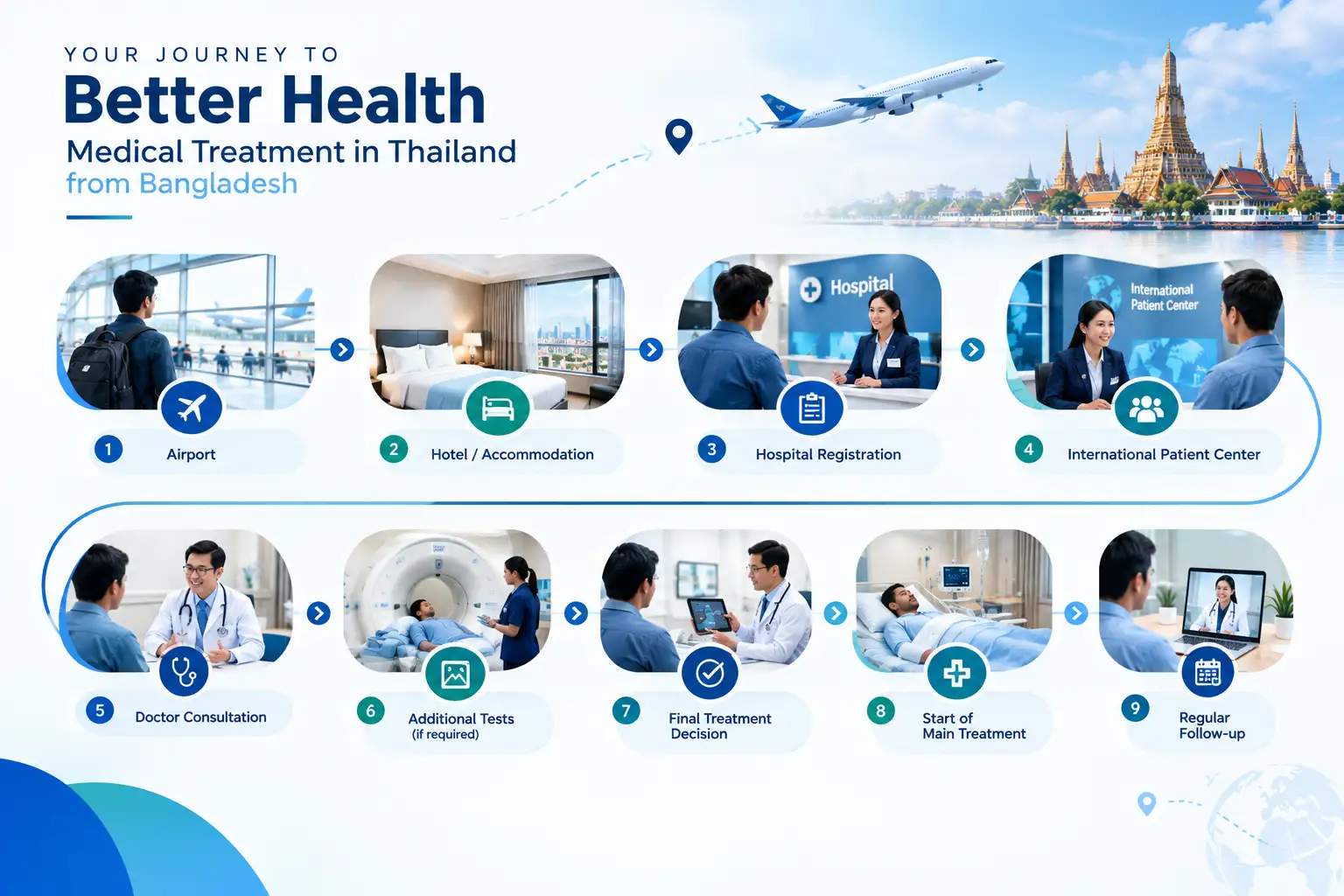
What to do if your medical plans change after arriving in Thailand
The report that the doctor sees in Bangladesh is mainly based on imaging or pathology reports. However, after a direct physical examination (Clinical Evaluation), the doctor may make slight changes to your original treatment. This is a very normal process and the doctor does this in the interest of proper treatment.
It is necessary to discuss whether to handle this entire process yourself or seek the help of a professional coordinator.
Should You Arrange Treatment Yourself or Use a Coordinator?
You can contact the hospital directly to get treatment in Thailand, or you can seek the help of a medical tourism coordinator or professional agency.
| If you do it yourself | If done through a coordinator |
| Finding and choosing a hospital yourself | Help in getting a list of suitable hospitals according to your choice |
| Contact the hospital directly by email. | Facilitate communication and quick response |
| Email the report yourself | Benefits of sending medical reports in a proper format |
| Prepare your own visa file | Assistance in preparing necessary visa documents |
| Making your own travel and accommodation arrangements in Thailand | Hotel, airport pickup and local logistics assistance advice |
If you have prior experience traveling to Thailand, it’s best to do it yourself. If you want to make things hassle-free and easy, it might be convenient to engage an experienced medium.
How Can Dr Abdullah Al Mamun Help With Medical Travel to Thailand?
If you are worried about organizing complex medical reports, finding a good hospital, or handling visas and appointments for Thailand, you can receive expert support through Dr. Mamun’s medical tourism service.
Our service framework includes:
- Medical Report Review: Preparation for sending accurate and organized reports.
- Hospital and doctor coordination: Quickly get the opinion of a doctor from the right department.
- Appointment and Cost Estimate: Collecting hospital invitation letters.
- Organizing visa files: Essential guidelines for medical visa.
- Travel and Thailand Logistics Support: Providing accurate information about hotel and airport pickup.
- Follow-up service: Maintaining medical follow-up with the Thai doctor even after returning to Bangladesh.
If you want to simplify your medical travel planning, you can contact us today.
FAQs about Getting Medical Treatment in Thailand from Bangladesh
What are the ways to get medical treatment in Thailand from Bangladesh?
To get treatment in Thailand from Bangladesh, first select a specialist doctor and hospital. Then send your medical report to the Thai hospital and collect the appointment and cost estimate. Based on this, book a visa and air ticket and travel to Thailand for treatment.
Can Bangladeshi patients easily get treatment in Thailand?
Yes, Bangladeshi patients can easily receive modern medical services in Thailand by submitting the correct medical report, hospital invitation or appointment letter, and necessary visa documents.
What documents are required when sending a report to a Thai hospital?
It is necessary to send diagnosis reports, recent pathology and blood test results, X-ray/MRI/CT scan files, details of previous operations, and a list of medications currently being taken.
Is it possible to get a doctor’s opinion before going to Thailand?
Yes, most Thai international hospitals in Bangladesh provide an initial medical review and an estimate of the cost if you send the report via email or an authorized representative.
5. How much does it cost to get medical treatment in Thailand?
The cost depends on the type of treatment, the quality of the hospital, the patient’s condition, and the length of stay in the hospital. It is usually necessary to budget for the cost of hotels, flights, visas, and transportation in addition to the basic medical bill.
What type of visa is required for medical treatment in Thailand?
Depending on the duration and circumstances of the treatment, you need to apply for a Medical Visa or a Tourist Visa. Before applying for a visa, you should check the current policy on the official website.
Can anyone from the family accompany the patient?
Yes, a family member or close relative can travel with a visa as a medical attendant with a patient traveling for treatment.
Is it mandatory to seek the help of a professional coordinator for treatment in a Thai hospital?
No, it is not mandatory. You can contact the hospital directly if you wish. However, many people use the help of a coordinator or professional agency to make the process hassle-free and time-saving.