

One of the most important questions when deciding to go to Thailand for medical treatment is: which hospital is right for your specific treatment? How to choose a hospital in Thailand is not simply about finding the most reputable or largest hospital. Many people assume that a well-known hospital will automatically provide the best treatment, but your decision should also consider your specific medical condition, doctor expertise, and treatment requirements.
Choosing the right hospital for a Bangladeshi patient is not just about choosing a beautiful building; it is also about finding a doctor with relevant expertise, reliable international patient support, transparent treatment costs, and a practical follow-up plan after returning to Bangladesh. In this guide, we will explain step-by-step how to evaluate and choose the right hospital in Thailand for your treatment.
What Makes a Hospital Suitable for International Patients?
A hospital is suitable for international patients only when it has the right medical departments, certified specialists, international safety standards, and proper follow-up facilities.
| Factor | Why It Matters for Patients |
| Medical Specialty | The hospital has the appropriate department, specialist team, or treatment program for your condition |
| Accreditation | Provides evidence that the hospital has been assessed against defined quality and safety standards. |
| Doctor Experience | The doctor’s personal experience and case volume in a specific disease or procedure. |
| International Patient Support | Dedicated team for visa assistance, language translators, and report coordination. |
| Cost Transparency | Having a clear idea of the estimated medical costs and no hidden charges. |
| Location & Logistics | Transportation from the airport and accommodation for an accompanying attendant. |
| Post-Treatment Continuity | Ease of communication with doctors and hospitals after returning to Bangladesh after treatment. |
Start With Your Medical Condition, Not the Hospital Name
The first mistake when looking for a hospital in Thailand is to list the most reputable hospitals before deciding on the type of treatment. The first thing to do is to identify your medical condition correctly, identify the physical problem and find the right department accordingly.
hospital may have many departments, but that does not automatically mean every department has the same expertise for your specific condition or procedure. For example:
- Acne and skin problems: Dermatology and Cosmetic Services
- Cancer treatment: Oncology
- Heart disease: Cardiology / Cardiac Surgery
- Knee or joint replacement: Orthopaedics
- Infertility treatment: Reproductive Medicine / IVF
If you want to go for advanced treatment for complex skin diseases or acne scars, you should not just look at the brochure of the general hospital but also look at the experience of their dermatology department. Similarly, in the case of a complex condition, it is important to check whether there are specific treatment procedures for that particular issue.
To learn more about skin or dermatological conditions, you can see the related guide Types and treatment of deep acne scars.
Hospital Accreditation: What JCI Tells You (And What It Doesn’t)
When it comes to world-class hospitals, many people first look for JCI (Joint Commission International) accreditation. JCI is an international organization that monitors patient safety and quality standards in hospitals. However, it is important to understand what exactly JCI does and does not guarantee.
What JCI Tells You:
JCI accreditation indicates that the organization has been assessed against JCI’s applicable quality and patient-safety standards.
What JCI Does NOT Tell You:
JCI accreditation does not guarantee the individual skills of your specific doctor, his or her surgical success rate, or the individual results of your treatment.
Is JCI Accreditation Enough?
No, JCI alone is not enough. Thailand has its own national accreditation system, which is administered by the Healthcare Accreditation Institute (HA). Thailand’s national HA and the international JCI essentially complement each other.
Accreditation is only a basic basis, not the final decision, when choosing a hospital. It should be combined with departmental experience and doctor expertise to make a decision.
Check the Doctor, Not Just the Hospital
You will be receiving treatment from a doctor, not a hospital building. So, in addition to choosing a hospital, you should also check who your doctor will be.
Check these things when choosing a doctor:
- Whether the doctor has a specific specialty and a board-certified degree.
- What is the doctor’s experience with your specific condition or procedure?
- How many such cases does the doctor handle on a regular basis?
- Is the doctor reviewing all your previous medical records before traveling to Thailand?
It’s not enough to just write “15 years of experience” on a medical biodata or profile. The important questions are:“How often does this doctor regularly handle my current medical condition or case?”
Evaluate International Patient Support & Experience
Many major private hospitals in Thailand provide dedicated international-patient or international-services teams. This is not merely a standard information desk or a WhatsApp number.
An effective International Patient Department will provide you with the following services:
- Medical Records Review: Review the report by a Thai doctor before traveling.
- Treatment Estimates: Provide detailed information about the estimated cost and possible length of stay.
- Visa & Logistics: Some international patient departments can assist with treatment-related documents, invitation letters, or other travel/visa coordination where applicable. Confirm what the hospital provides before applying.
- Discharge & Continuity: Prepare test reports and discharge summaries correctly after treatment.
- Language & Interpreter Support: Some Thai hospitals offer Bengali interpretation or Bangladesh-specific international patient support. Confirm availability before travelling, as language services vary by hospital and may need advance arrangement.
Having an effective international coordination team is crucial for getting answers to urgent questions and for clear communication with doctors.
Compare the Treatment Plan, Not Just the Price
When considering medical treatment in Thailand, it can be a mistake to make a decision based solely on price quotes from two different hospitals. If Hospital A quotes ฿50,000 and Hospital B quotes ฿80,000, it is incorrect to simply assume that Hospital A is the cheaper option; you must compare the scope of the packages offered by both hospitals.
A proper written treatment estimate should include details on the following:
- Doctor’s fees and consultation charges
- All necessary pre-surgery diagnostic tests
- Main procedure or operation room charge
- Details of the medical device, implant, or medication used
- Hospital stay and ICU cover details
- Post-treatment follow-up costs
To get a clear idea of the overall budget and travel expenses, you can read our guide on the estimated cost of medical treatment in Thailand and the article on medical travel costs from Bangladesh to Thailand.
6. Communication & Post-Treatment Care in Bangladesh
One of the biggest mistakes in medical travel is not thinking about what will happen after you return home. You need to maintain continuity of care even after you return to Bangladesh after completing your treatment in Thailand.
Before choosing a hospital, make sure:
- Doctors in Thailand will give you a detailed discharge summary and whether they will provide all diagnostic reports.
- Is there any opportunity for the Thai medical team to communicate with your local Bangladeshi doctor?
- Is there an opportunity to receive remote or online consultation if any side effects or complications arise after returning home?
Treatment does not end immediately after leaving the hospital; rather, continuing follow-up after returning to Bangladesh is the key to a safe recovery.
Big Hospital vs Specialist Clinic: Which Should You Choose?
Many patients are confused about whether to go to a large multi-speciality hospital or a small, specialized clinic. There is really no single universal answer—the choice depends on your condition.
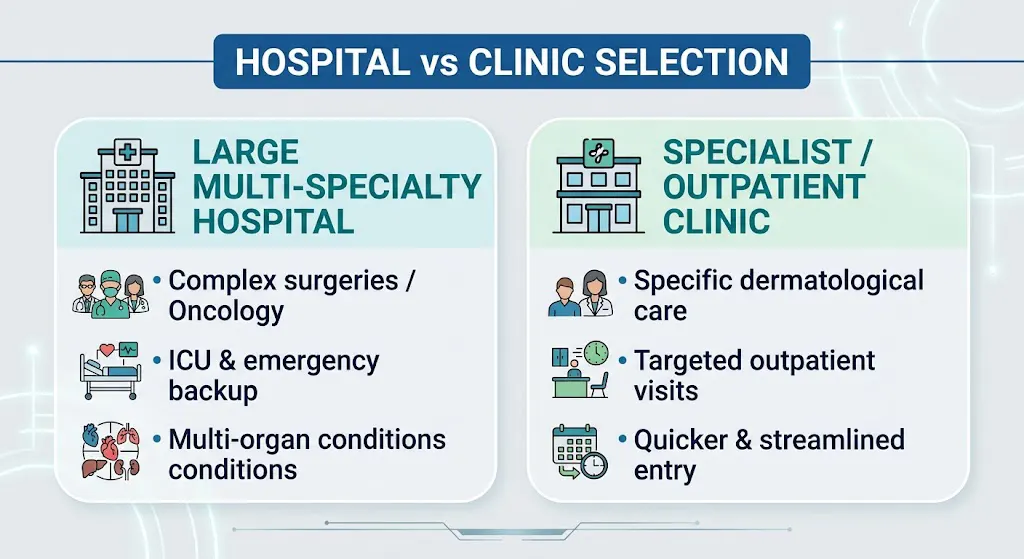
If the medical condition is complex or there is a possibility of ICU support, a multi-speciality hospital is safer. For straightforward outpatient care, a specialist clinic may be suitable if the required diagnostic, procedural and emergency support is available.
For example, when deciding between Bangkok and Dhaka for acne treatment, melasma management, or other skin treatments, you need to consider the complexity of your condition.
Should You Choose a Hospital Based on Google Reviews?
While Google reviews are useful for general experience, you should not make medical decisions about a hospital based solely on reviews.
- What Google Reviews are GOOD for: To learn about staff behavior, waiting times, room cleanliness, and international support experiences.
- What Google Reviews CANNOT Tell You: A qualified surgeon’s clinical skills, success of complex operations, or overall safety standards.
Google star ratings can never be a measure of a doctor’s medical ability.
The MATCH Framework for Choosing a Hospital in Thailand
To easily find the right hospital, you can use our special MATCH Framework. You can use:
| Letter | Focus Area | Essential Questions to Ask |
| M | Medical Specialty | Does the hospital operate a specialized center for your specific disease? |
| A | Accreditation & Safety | Does the hospital have JCI or national HA safety accreditation? |
| T | Treating Doctor | Who will treat you and what is their experience in similar cases? |
| C | Communication | Is their international department capable of understanding the report and providing accurate advice? |
| H | Hospital Plan & Follow-up | Is there a written estimate and a proper communication plan from Bangladesh? |
How to Shortlist Thai Hospitals: A Practical 5-Step Process
If you want to choose a hospital in Thailand yourself, you can proceed in these 5 steps:
- Define Your Medical Need: Find out the specific medical category according to your current report.
- Shortlist 3 Hospitals: Choose 3 possible hospitals according to your condition.
- Verify Doctor & Accreditation: Check the accreditation of hospitals and the biodata of doctors in specific departments.
- Send Records for Assessment: Send your medical reports and request a written consultation and treatment estimate.
- Compare Plan & Continuity: Make a final decision by considering costs, logistical support, and follow-up facilities after returning to Bangladesh.
If you want to know more about the overall process and visa, you can take a look at our comprehensive article on how to go to Thailand for medical treatment.
Red Flags When Choosing a Hospital in Thailand
These precautions should be kept in mind when choosing a hospital:
- Unclear pricing: The hospital or coordinator cannot explain what the estimate includes or excludes.
- Claiming 100% guaranteed results before undergoing treatment.
- Simply branding the building without providing the name of the specific doctor or their background information.
- Creating extra pressure to book or pay quickly.
- No guidance regarding follow-up after returning to Bangladesh.
Hospital Directly vs Using a Medical Coordinator
International patients can contact medical treatment in Thailand in two ways, directly with the hospital or through a professional medical coordinator.
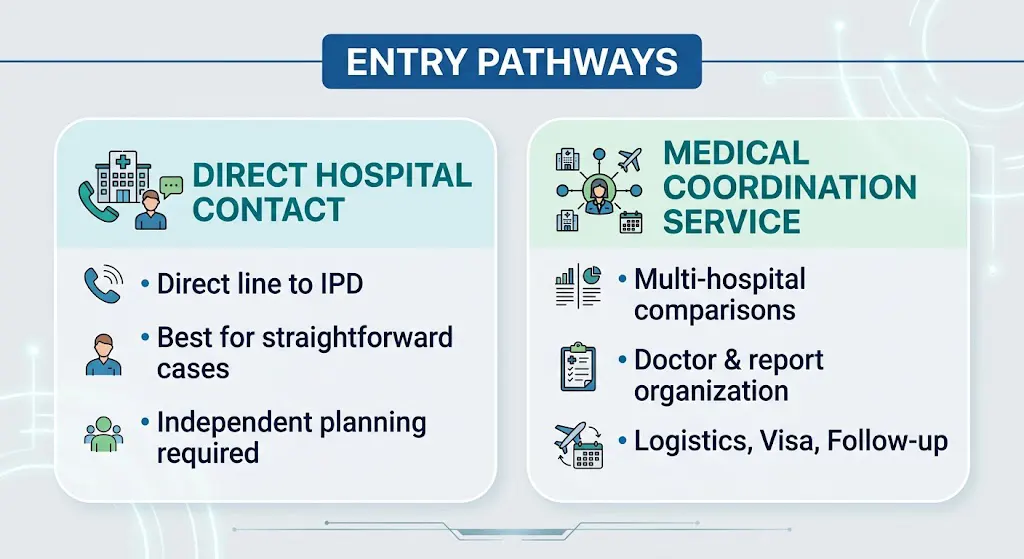
Medical coordinators are never a substitute for a doctor or hospital, but they can help organize and coordinate your reports, present them to the right specialist, and provide referrals.
Need Assistance Finding the Right Thai Hospital?
If you are not sure which hospital or doctor in Thailand is most suitable based on your current report, you can review your medical report and seek appropriate advice.
We can help you organize your medical reports, identify the relevant specialty, and coordinate with appropriate hospitals for treatment planning.
Explore Medical Tourism Support
FAQs about Choosing a Hospital in Thailand
How do I choose a hospital in Thailand for medical treatment?
First, identify the appropriate medical speciality based on the nature of your condition or illness; then decide after evaluating experienced doctors in that department and the hospital’s international-standard facilities.
Is JCI accreditation essential for choosing a Thai hospital?
JCI accreditation can be a useful quality and patient-safety signal, but it should not be the only factor. Thailand also has a national hospital accreditation system through the Healthcare Accreditation Institute (HAI). These are separate accreditation systems, so patients should consider accreditation alongside the hospital’s specialty, doctors, treatment experience, international-patient support and follow-up plan.
Can I choose a hospital based solely on low cost?
Decisions should not be made solely based on low cost, as low-cost packages may not include many necessary diagnostic tests, surgery charges, or ICU cover.
How do I verify a Thai doctor’s credentials?
You can check the doctor’s specialty certificate, training background, and recent experience in the procedure for your disease from the official websites of the hospitals.
What is the advantage of choosing a specialist clinic over a large hospital?
A specialist clinic may be appropriate for selected outpatient conditions or procedures, provided it has the facilities and specialist support your treatment requires.
How do I get a written treatment estimate from a Thai hospital?
You can request an estimated cost breakdown by sending your latest medical reports, diagnostic files, and a description of your physical condition to the hospital’s International Patient Department.
Will Thai hospitals provide Bengali translation support?
Some major hospitals in Thailand provide Bengali interpretation or Bangladesh-specific patient services, but availability varies by hospital. Confirm the language support before travelling.
How does follow-up work after I return to Bangladesh?
Ask the hospital for your discharge summary, diagnostic reports, prescriptions and other relevant treatment records so that follow-up can continue after you return to Bangladesh